


Parasailing with Burj Al Arab Views: Dubai’s Most Iconic Aerial Experience
📖 8 min read | Last Updated: January 3, 2026
Some experiences define a destination.
In Paris, it’s seeing the Eiffel Tower.
In New York, it’s the Statue of Liberty from the harbor.
In Dubai, floating 150 meters above the Arabian Gulf with the Burj Al Arab rising behind you might be the most defining visual experience you can have.
This isn’t ordinary parasailing. This is parasailing with the world’s most photographed hotel as your backdrop — an experience that combines the serenity of flight with the visual impact of one of the most recognizable buildings on Earth.
Why Burj Al Arab Makes the Difference
The Burj Al Arab isn’t just any building. Designed to resemble the sail of a ship, standing on its own artificial island, operating as the world’s only self-proclaimed 7-star hotel, it represents Dubai’s entire philosophy: dream impossibly big, then build it anyway.
From ground level, the Burj Al Arab is impressive but somewhat distant.
You see it from beaches, from roads, from the decks of boats.
But there’s always something between you and the building — barriers, other tourists, the flat perspective of viewing from sea level.
From the air, the relationship changes entirely.
You’re no longer looking up at the Burj Al Arab; you’re looking across at it.
The full sail shape becomes apparent, the way the building catches light on its distinctive panels, the impossibility of its position standing alone in the water.
You see Dubai’s ambition made physical, and you’re floating beside it.
The experience isn’t just about the hotel, of course.
The Jumeirah coastline stretches away from you, dotted with luxury residences and beach clubs.
The Gulf sparkles below.
The Dubai skyline forms a distant backdrop.
But the Burj Al Arab anchors everything — it’s the visual proof that you were here, doing this, in one of the most extraordinary cities on Earth.
The Experience: What Actually Happens
Getting There
Parasailing with Burj Al Arab views typically launches from the Jumeirah Beach area, specifically from stations near Umm Suqeim Beach or other points along the coastline closest to the hotel.
Arriving at the departure point, you’ll see the Burj Al Arab rising nearby — a preview of what you’ll see from the air.
The check-in process is standard: show identification, sign a waiver, receive a brief safety orientation.
The crew will ask about your weight and may group you with other flyers if space on the boat allows.
The safety briefing covers what to expect during flight, how the harness system works, and what signals the crew will use to communicate with you. Nothing here is complicated — parasailing requires almost no action from participants — but understanding the process reduces anxiety and lets you focus on enjoyment once you’re airborne.
The Takeoff
The speedboat heads out from shore, and you watch the Burj Al Arab shift perspectives as you move across the water. From the boat deck, it’s already impressive — that sail shape growing larger, the detail of the helipad visible at the top, the impossibly blue sky framing everything.
When it’s your turn, you’re fitted into the harness and take position on the takeoff platform at the boat’s stern.
The crew attaches you to the parasail, checks all connections, and then signals the boat captain.
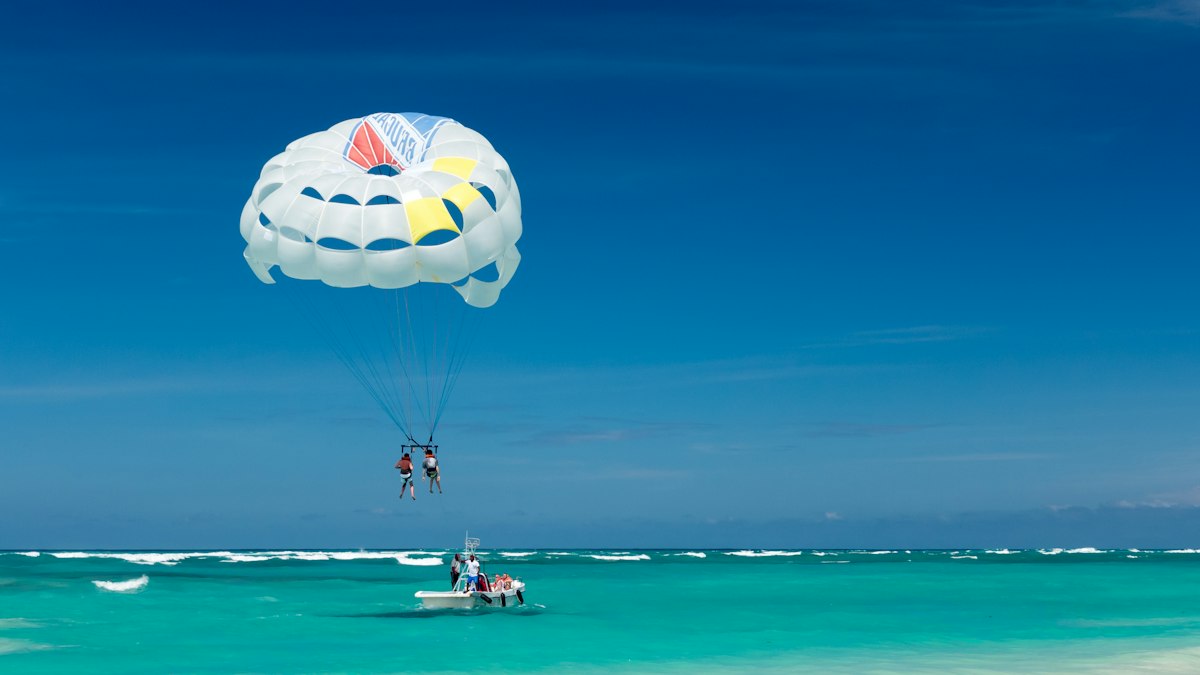
The engine note rises, the boat accelerates, and within seconds, the parachute catches air and you’re lifting off.
The ascent is remarkably gentle.
No jerking, no sudden acceleration — just a smooth rise as the line pays out from the boat.
The sounds of the engine fade.
The other people on the boat become smaller.
And the Burj Al Arab, which was impressive from deck level, becomes transcendent from 100, then 150 meters in the air.
At Altitude
What strikes first-timers most is the silence.
You expect wind noise, chaos, turbulence — but parasailing at cruising altitude is remarkably peaceful.
The parachute creates a stable platform, the harness distributes your weight comfortably, and you’re essentially sitting in the sky.
The Burj Al Arab dominates your visual field in the best possible way.
Depending on the wind direction and boat positioning, you might see it to your left, right, or directly ahead.
The building seems both closer than from ground level (because of your elevated perspective) and more fully realized (because you’re seeing its complete shape rather than looking up at a foreshortened version).
Around you, the full context of Dubai becomes apparent.
The Jumeirah Beach coastline reveals its expensive real estate — the mansions, the hotels, the pristine beaches.
The Gulf stretches to the horizon in shades of turquoise and blue.
To the north, the Marina towers punctuate the skyline.
To the south, the coast continues toward Abu Dhabi.
Your phone, if you’ve brought one in a waterproof case, becomes precious.
The photos from this perspective are unlike anything you can get from ground level — the Burj Al Arab at eye level, the water sparkling below, the Dubai sky around you.
Some people spend their entire flight time photographing; others put the phone away and simply absorb the experience.
Both approaches are valid.
The Descent
After 8-15 minutes (depending on your package), the boat begins slowing and the crew starts winding in the line. The descent is as gentle as the ascent — you float down toward the boat deck, the Burj Al Arab remaining visible until you’re nearly at deck level.
Most descents are dry — you land directly on the boat platform without touching water.
Some operators offer an optional “dip” where they lower you close to the water during descent, dipping your feet or more into the Gulf.
This is fun on a hot day but leaves you wet for the boat ride back.
Once you’ve landed and been unclipped from the harness, there’s usually a moment of processing.
The experience was short but intense — 15 minutes that felt like both more and less than that.
The Burj Al Arab is still there, now back to its ground-level perspective, but you’ve seen it differently now.
Making the Most of This Experience
Timing for the Best Views
Morning parasailing offers calm conditions and soft, golden light that makes the Burj Al Arab’s panels glow.
The building faces roughly northeast, so morning sun illuminates its western face beautifully.
Wind is typically lightest before 10 AM, creating smooth, stable flights.
Afternoon flights can be slightly choppier but offer different light angles.
The eastern face of the building catches afternoon sun, creating different visual effects.
If you’re flexible on timing, morning is generally superior, but afternoon flights are certainly viable.
Sunset parasailing is magical but limited.
The golden hour light makes everything more beautiful, including the Burj Al Arab.
However, sunset slots book up quickly and are sometimes affected by late-afternoon wind patterns. The price is the same as any other slot.
If you can secure a sunset slot on a calm day, take it — but don’t be disappointed if conditions don’t cooperate.
Maximizing Your Photos
If photos matter to you, consider these strategies:
Bring a properly secured phone. Waterproof cases with lanyards are essential — dropping your phone from 150 meters into the Gulf is both common and unrecoverable.
Shoot more than you think you need. The conditions are unusual for phone cameras: bright sky, movement, unusual angles. Taking 50+ photos gives you options; taking 5 probably leaves you with zero keepers.
Consider the operator’s photo package. Professional photos taken from the boat often provide angles you can’t get yourself — they capture you in flight with the Burj Al Arab behind you. Your own shots show the view from your perspective; their shots show you having the experience.
Alternate between photographing and experiencing. The temptation to spend the entire flight staring at your phone screen is real but unfortunate. Force yourself to put the phone down for at least a few minutes and just be present in this remarkable moment.
Booking Strategy
For Burj Al Arab views specifically, confirm that your operator launches from a location that actually offers these views. Some Dubai parasailing operators launch from the Marina area, which gives you Marina skyline views but not close Burj Al Arab perspectives.
Book in advance during peak season (November through March).
Sunset slots book first, followed by morning slots.
Midday availability is usually better but conditions are hotter.
If weather forces a cancellation, reputable operators will reschedule at no cost. Ask about cancellation policies when booking, and don’t book with operators who are unclear about this.
The Comparison Question
Visitors often ask whether Burj Al Arab parasailing is better than parasailing from other Dubai locations. The honest answer depends on what you’re prioritizing.
Burj Al Arab parasailing is best if:
You want the most iconic possible photos. Nothing else in Dubai creates such immediately recognizable imagery.
The Burj Al Arab specifically matters to you. If this building represents something — luxury, aspiration, Dubai’s identity — then seeing it from the air is meaningful.
You’re doing parasailing once and want the most Dubai-specific experience. This location delivers maximum visual distinctiveness.
Marina parasailing might be better if:
You’re staying in the Marina area and convenience matters. The Jumeirah location is a bit farther for Marina hotel guests.
You prefer urban skyline views to single-building focus. The Marina’s forest of towers is spectacular in its own right.
You’ve seen Burj Al Arab extensively and want variety.
In practice, the Burj Al Arab location is what most visitors choose when they have the option. The building’s iconic status makes it the default “best” choice for most first-time Dubai parasailers.
Beyond the Views
While the Burj Al Arab views are the headline attraction, this parasailing location offers more than just one building.
The Jumeirah coastline visible from the air includes Madinat Jumeirah (a resort complex designed to evoke traditional Arabia), Wild Wadi Waterpark, and some of Dubai’s most expensive residential real estate. The contrast between the ultra-modern Burj Al Arab and the deliberately traditional Madinat is striking from above.
The water clarity near Jumeirah is typically excellent, allowing you to see variations in depth and color below you. On calm days, you might spot boats, swimmers, and marine life from your elevated perspective.
Looking inland, you see how abruptly Dubai’s urban development ends at the edge of the desert. This contrast — one of the world’s most ambitious cities sitting on the edge of empty sand — is something you perceive from the air more clearly than from any ground-level vantage point.
Book Your Burj Al Arab Parasailing Experience
At Volna Tours, we offer parasailing from locations with optimal Burj Al Arab views:
- 🌊 Jumeirah Beach departures with hotel backdrop
- 🌊 Experienced crews with thousands of flights
- 📸 Photo packages to capture the moment
- 🌊 Flexible scheduling including sunset options
- 🌊 Clear weather policies with free rescheduling
Written by Volna Tours Team
“Professional water sports operators with 5+ years of experience in Dubai. Licensed by Dubai Maritime City Authority. We provide safe, memorable jet ski, parasailing, and jet car experiences across Dubai’s best locations.”
— Licensed Operator | Dubai Maritime City Authority